A familiar sequence
The internet's mass adoption ran through a now-familiar sequence: early skepticism, uncontrolled experimentation, infrastructure strain, moral panic, and eventual integration into nearly every sector of life. We have watched the same movie since, most recently with AI.
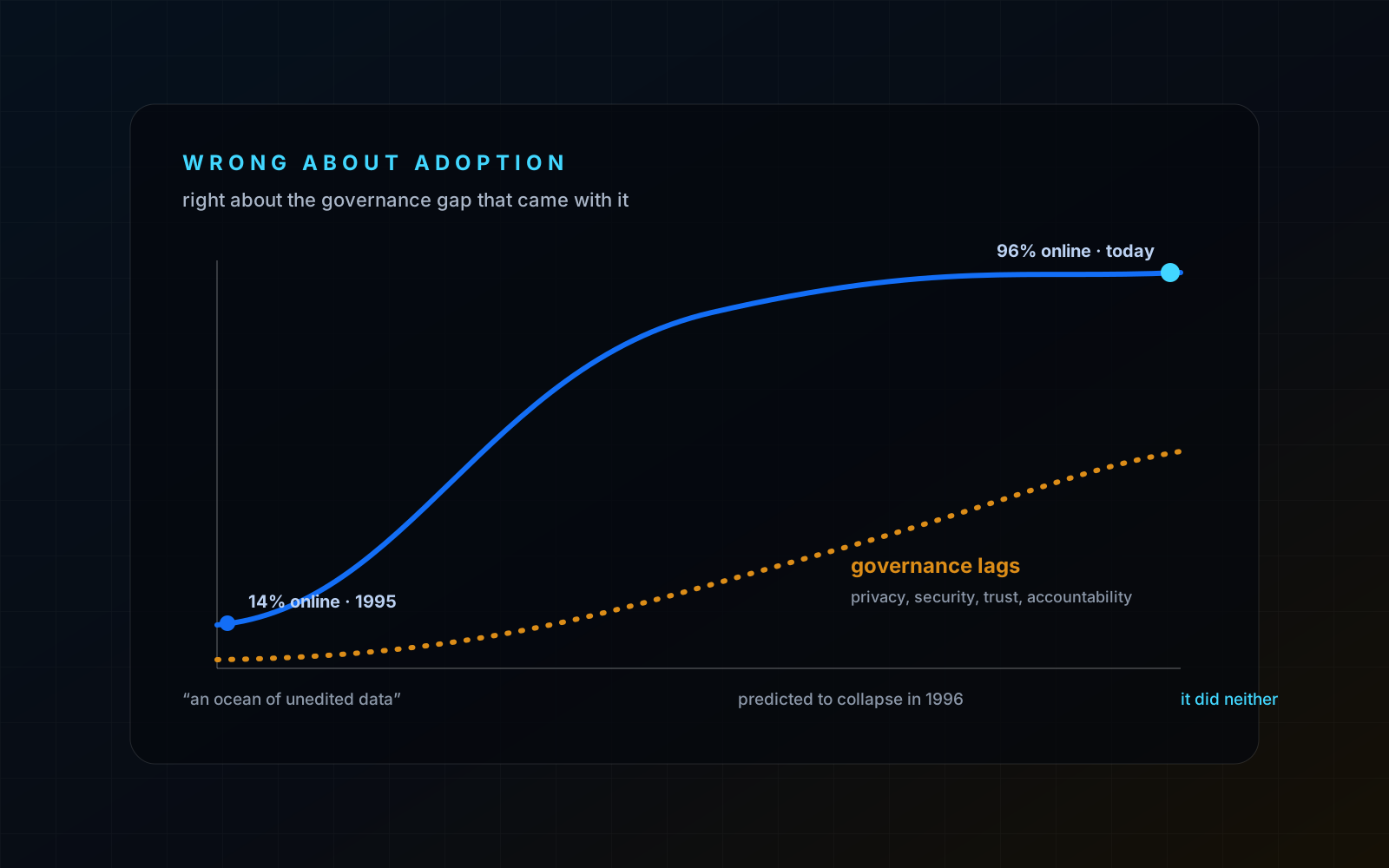
The numbers capture how far it traveled. In 1995, Pew found that only 14 percent of US adults had internet access, and many Americans had either never heard of the internet or had only a vague sense of it. By early 2000, about half of US adults were online. Today, 96 percent of US adults say they use the internet.
From near-novelty to near-universal in a generation. That trajectory is worth holding in mind, because the people who were loudest at the start were often confidently wrong about where it would end.
The skeptics were sharp, and wrong about adoption
The skepticism was not lazy. In a 1995 Newsweek essay, Clifford Stoll described the internet as an ocean of unedited data and a wasteland of unfiltered data, arguing that users would struggle to know what was worth reading. Robert Metcalfe, the Ethernet pioneer, predicted the internet would go spectacularly supernova and catastrophically collapse in 1996.
Metcalfe later, famously, ate his words, literally, after the collapse failed to arrive. The adoption predictions were simply wrong. The internet did not fail, did not collapse, and did not remain a niche curiosity for the technically inclined.
It would be easy to file these away as cautionary tales about doubting new technology. That is the wrong lesson, and drawing it leads organizations to dismiss legitimate concerns about AI by pointing at people who underestimated the internet.
The same skeptics were often right about governance
Because here is the part that gets forgotten: those predictions were wrong about adoption but not useless. They identified real transition risks: information overload, trust failure, capacity constraints, and unclear business models. The internet did not collapse, but it did produce spam, fraud, misinformation, cybercrime, privacy loss, platform dependence, and new forms of manipulation.
So the skeptics were wrong that the technology would fail, and frequently right that uncontrolled adoption would create serious institutional problems. Both things are true at once, and keeping them separate is the key analytical move.
Stoll mistook a governance problem for an adoption problem. The ocean of unedited data was real. It just was not a reason the internet would not be adopted; it was a description of a problem we would spend the next thirty years building institutions to manage.
Separate the two questions for AI
This distinction is essential for AI. Skepticism about adoption and skepticism about governance are not the same thing. A person can be wrong to claim AI will not be adopted while being right that AI will create reliability, bias, security, privacy, labor, intellectual-property, and accountability problems.
Organizations should not dismiss governance concerns simply because earlier skeptics underestimated adoption. Nor should they block adoption because risks exist. Both moves collapse two separate questions into one and get the answer wrong.
The disciplined move is to ask them independently. Will this technology diffuse? Almost certainly yes. What controls are needed for safe, productive use? That is a real, answerable question, and it deserves its own serious work rather than being waved away by the adoption answer.
Early business models are usually crude
The internet also shows that early business models tend to be crude. In the 1990s, many organizations treated websites as brochures. Retailers experimented with e-commerce before logistics, payments, personalization, and customer service were mature. Media companies put content online without understanding the revenue implications.
Enterprises connected systems before they grasped their cybersecurity exposure. The technology diffused faster than the governance, the operating models, and the economics around it. The capability outran the institutions, and the institutions spent years catching up.
AI is in that phase now. Many organizations use it as a thin layer on top of existing work: draft this email, summarize this document, generate this code. Useful, and incomplete. The more strategic question is how AI changes service, research, development, compliance, procurement, sales, onboarding, and decision-making, and most organizations have not asked it yet.
The governance lag is the recurring trap
Privacy rules, cybersecurity frameworks, platform governance, digital identity, content moderation, and consumer protection all developed after internet adoption was already widespread. Governance lagged, and society absorbed the cost of the gap.
AI is moving through the same gap, faster. Organizations cannot wait for perfect regulation before acting, because adoption is not waiting. But they also cannot let every employee use any tool with any data for any purpose, because that is how the gap turns into incidents.
So they need internal rules now: what data can be used, which tools are approved, where human review is required, how outputs are verified, how incidents are escalated, and who is accountable. Not a finished regulatory regime, just enough governance to make safe use easy and risky use visible while the external rules catch up.
What to take from the internet
The internet became far more than a communications channel. It reorganized discovery, distribution, commerce, media, and social life. AI will become far more than a productivity assistant in the same way, by becoming part of how work is structured rather than a tool sitting beside the work.
The mistake to avoid is treating the early, crude phase as the permanent shape of the technology. Judging AI by today's draft-an-email use case is like judging the internet by the brochure website. The interesting part has not happened yet.
Hold both truths the skeptics split between them. AI will diffuse, probably faster than anything before it. And uncontrolled diffusion will create real problems that thoughtful governance can prevent or contain. Plan for both, and you are already ahead of where most organizations were during the internet's first decade.