Inference is more than a token-price conversation
The case for smaller and open-weight models usually gets framed as a cost argument. True, but only half the story. Inference is not just a line item on a bill; it is turning into strategic infrastructure.
As more of a company's work runs through AI systems, the model call becomes part of the operating system of the business. That model might draft internal communications, summarize meetings, reason over financial data, review code, classify customer issues, pull contract terms, generate reports, and power agents that reach into internal systems.
At that point, which API is cheapest stops being the interesting question. The one that matters is which parts of the AI stack the company should own.
This is not a privacy panic
The argument for owning more of the inference path is not that the big model providers quietly train on enterprise data. Major providers make real enterprise, API, and commercial-product commitments. Admin settings, data-retention controls, product surfaces, and vendor security programs all count for something.
But not trained on by default is a long way from owning your architecture. The company still has to decide where data gets routed, which product surface people use, which connectors are on, which model version is live, which system prompt is applied, which tools get injected into context, and which logs it keeps for itself.
Those are architecture decisions, not just privacy toggles. They drive cost, stability, governance, observability, continuity, and whether the company can learn anything from its own AI usage.
Product-layer changes hit production work
The same underlying model can behave very differently depending on the system prompt, reasoning setting, context-management strategy, caching behavior, tool definitions, verbosity rules, retry logic, and product defaults. Buy only the vendor's chat surface and you inherit every one of those choices.
For casual use, fine. For production workflows, that is a real risk. Once AI is part of a financial-analysis process, a customer-support workflow, an engineering pipeline, a compliance process, or an internal reporting stack, a change in model behavior is not just a product update. It is an operational event.
This is why the harness matters. A company needs a way to notice when quality, cost, latency, schema adherence, or review burden shifts, even when the model name and the list price have not moved at all.
Inference deployment is a spectrum
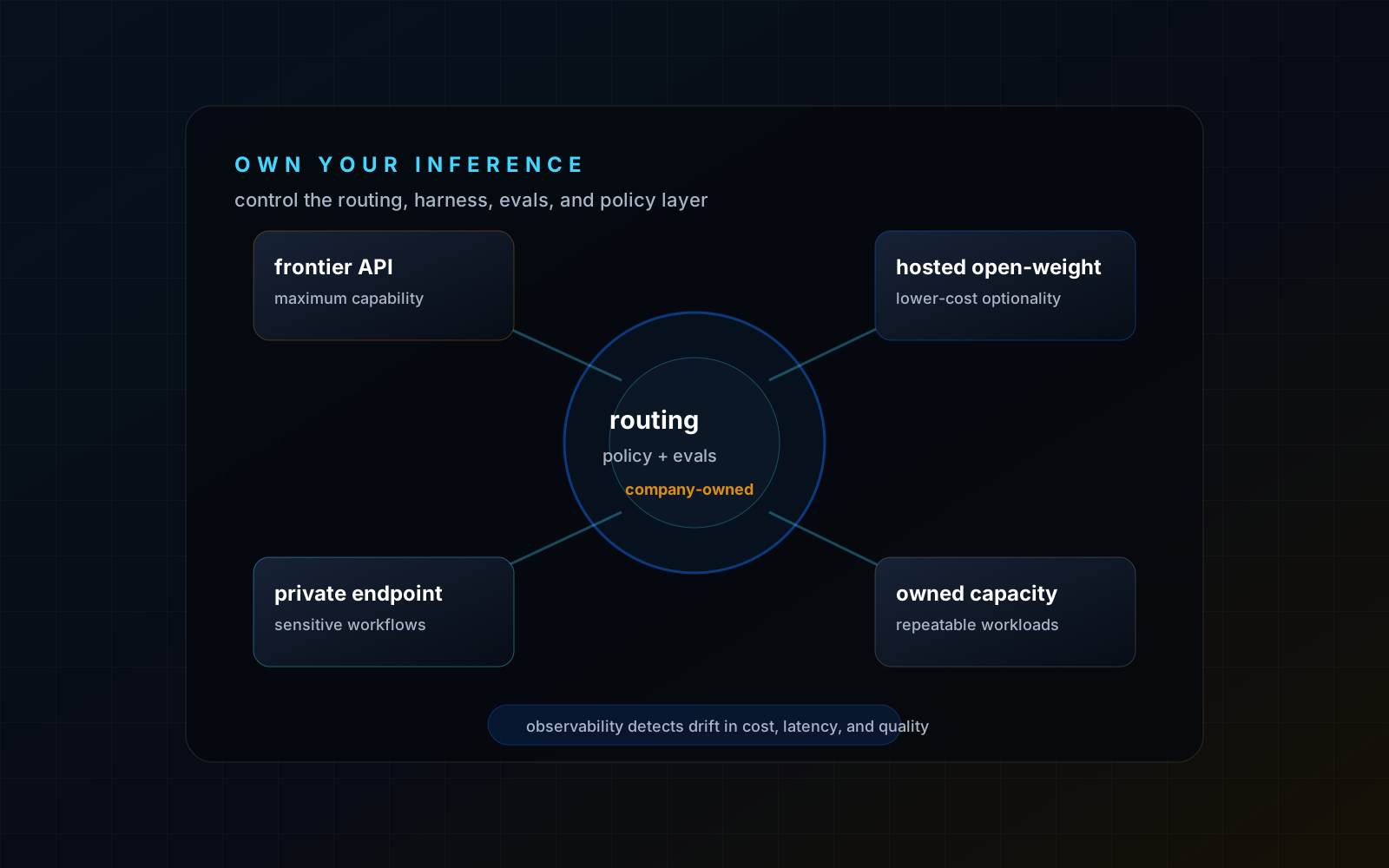
The conversation tends to get stuck in a false binary: cloud API or local model. Reality has more options. The useful deployment patterns include frontier APIs, smaller proprietary APIs, hosted open-weight inference, private hosted endpoints, dedicated GPU capacity, local or prosumer hardware, and hybrid routing.
Owning inference does not have to mean owning the GPU. It might mean owning the routing layer, the evals, or the prompt harness. It might mean leaning on hosted open-weight models, deploying certain models inside your own environment, or reserving GPU capacity for the workloads you run over and over.
For most enterprises the honest answer is hybrid. Let frontier models take the ambiguous, high-value, high-risk, or genuinely complex reasoning. Let smaller and open-weight models handle the routine work that has already cleared a benchmark. Look at private or dedicated capacity when a workload is high-volume, repeatable, and predictable.
Stability has economic value
Most cost discussions fixate on token prices and miss a major cost center: instability. A model can get more expensive without the list price ever changing. It can start writing longer answers, switch tokenizers, call tools differently, turn more verbose, regress on a task, need more retries, or stop following a schema as reliably as it used to.
Those changes cost money even when the price per token does not move. A week spent diagnosing why outputs got worse is a cost. Users who lose trust and start manually reviewing everything again are a cost. A workflow that quietly degrades is a cost, and so is a premium model that creeps up to more tokens per task.
Owning the harness, and more of the inference path, gives an organization a far better shot at catching and controlling those shifts before they settle in as invisible operating drag.
Control creates the learning loop
Owning more of the AI stack is not only about keeping data from leaking. It is also about learning from how the tools get used. If every employee interaction lives inside an external chat product, the company may never capture the signals that matter most: which tasks people bring to AI, which prompts repeat, which outputs get accepted, which models fail, and which tasks end up escalated.
That feedback loop is the asset. It tells the company which workflows deserve smaller models, which should escalate to frontier models, which examples should become eval cases, and which tasks would be better served by deterministic tooling, fine-tuning, or distillation.
You do not need to own every model or run every workload locally. You do need to own the decisions that determine cost, stability, security, and effectiveness: the benchmark, the routing policy, the harness, the evals, the logs, the escalation rules, and enough inference optionality that you are never trapped by one vendor, one interface, one model, or one pricing structure.