A productivity aid that became a management philosophy
Computerized spreadsheets are the best example of a tool that started as a productivity aid and quietly became a management philosophy. VisiCalc and Lotus 1-2-3 did not merely speed up arithmetic. They changed who could model a business decision.
Before spreadsheets, financial modeling was slower, more specialized, and more dependent on formal systems or manual recalculation. After spreadsheets, a manager, analyst, entrepreneur, or consultant could build a model, change assumptions, test scenarios, and present conclusions with new speed and confidence.
That shift in who gets to do the analysis turned out to matter more than the speed of the calculation. It moved analytical power outward, away from a small set of specialists and toward anyone willing to learn the grid.
The scale of the shift
Lotus 1-2-3 shows the magnitude. VisiCalc helped propel the Apple II; Lotus 1-2-3, with charting, graphing, and macros, quickly outsold it, generated 53 million dollars in Lotus's first year, and went on to dominate business software in the mid-to-late 1980s.
The spreadsheet became one of the defining applications of the personal-computing era because it combined computation, modeling, presentation, and user control in one place. It did not automate accounting so much as democratize analytical production.
That is the through-line to AI. The headline number is not really about a software package. It is about what happens to an organization when a capability that used to require specialists suddenly belongs to everyone.
Democratized power changes organizational politics
When analytical power spreads, so does influence. A junior analyst with spreadsheet skill could shape investment decisions, staffing plans, pricing strategy, acquisition analysis, and budgeting. The spreadsheet made business logic visible and manipulable.
It enabled what-if reasoning at a speed earlier systems could not match. Organizations could model uncertainty, compare options, and produce persuasive quantitative narratives on demand. The person who could build the model often shaped the decision.
AI extends that dynamic. The person who can get a useful answer out of a model, frame the prompt, supply the context, and package the output gains influence the way the spreadsheet-literate analyst once did. Capability migrates to whoever wields the new tool well.
The same qualities that create power create risk
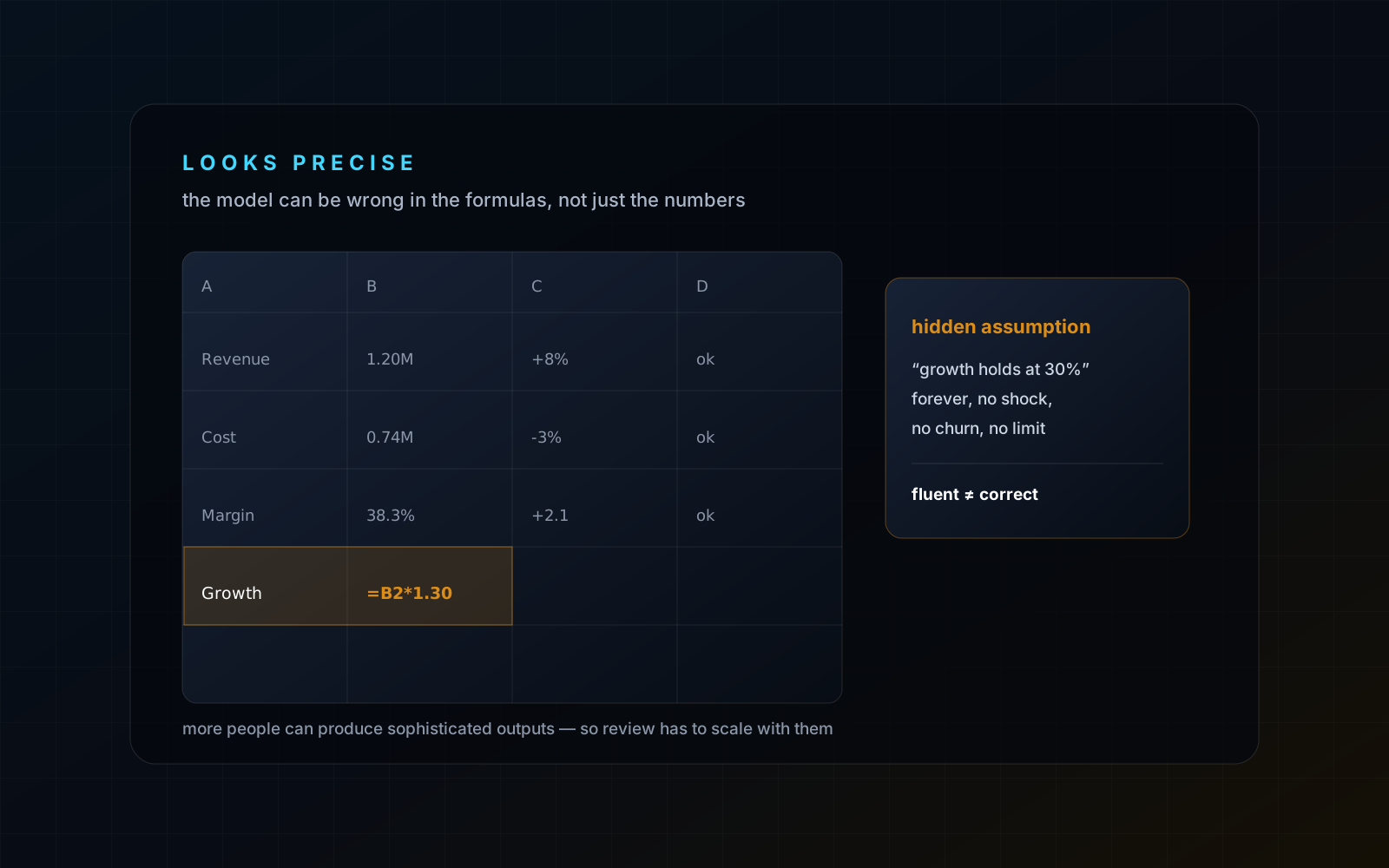
The qualities that made spreadsheets powerful also made them dangerous. In his 1984 essay, Steven Levy observed that spreadsheets let users duplicate the relationships among parts of a business and build models, and he warned that bad assumptions could be embedded not only in the data but in the formulas and relationships that govern the model.
That distinction is crucial. A spreadsheet can be wrong not because a number was mistyped, but because the structure misrepresents reality. The output can look rigorous while resting on fragile assumptions. The polish is not evidence of correctness.
Anyone who has inherited a sprawling financial model knows the feeling: the formatting is immaculate, the totals foot, and somewhere three sheets deep a single hardcoded growth rate is doing all the work. The artifact projects an authority that the underlying logic has not earned.
AI makes the same problem more persuasive
This maps almost exactly onto AI, with the volume turned up. A spreadsheet can make a flawed model look precise. AI can make flawed reasoning look fluent. A spreadsheet buries assumptions in formulas. AI buries them in prose, code, summaries, and recommendations.
A spreadsheet produces a professional-looking artifact that executives trust because it appears quantitative. AI produces a professional-looking artifact that readers trust because it appears articulate and confident. In both cases the form signals a rigor the content may not possess.
The lesson is not that spreadsheets were bad or that AI is bad. It is that both tools change the boundary between expert and non-expert production, and that fluency is not accuracy. The more polished the output, the more deliberate the verification has to be.
Review has to scale with the new producers
When more people can produce sophisticated outputs, organizations need new review disciplines. Spreadsheets eventually forced exactly that. In high-stakes contexts they led to model review, audit practices, version control, access controls, and financial-model standards.
AI will require analogous disciplines: source verification, model evaluation, human review at defined points, provenance tracking, output testing, and clearer accountability for AI-assisted work. The specifics differ, but the principle is identical, which is that democratized production demands proportional review.
The organizations that learned to govern spreadsheets did not ban them. They built the review layer that let non-specialists produce safely. That is the move with AI as well, and it is the subject of the playbook later in this series.
Do not surrender judgment to the artifact
Spreadsheets also reshaped how managers think. Once people could model scenarios easily, management became more quantitative, more scenario-driven, and more comfortable with abstraction. That produced real gains, and a real bias: a tendency to believe that what could be modeled was what mattered most.
AI may produce a similar shift. Once an organization can generate documents, analyses, code, and recommendations instantly, it can start to overvalue speed and polish while undervaluing judgment, context, and verification. The artifact gets more convincing even when the thinking behind it does not.
The managerial task is to capture the productivity benefit without surrendering judgment to the artifact. Use the tool to produce more and faster, and hold the line that fluent output is a draft to be checked, not a conclusion to be trusted.