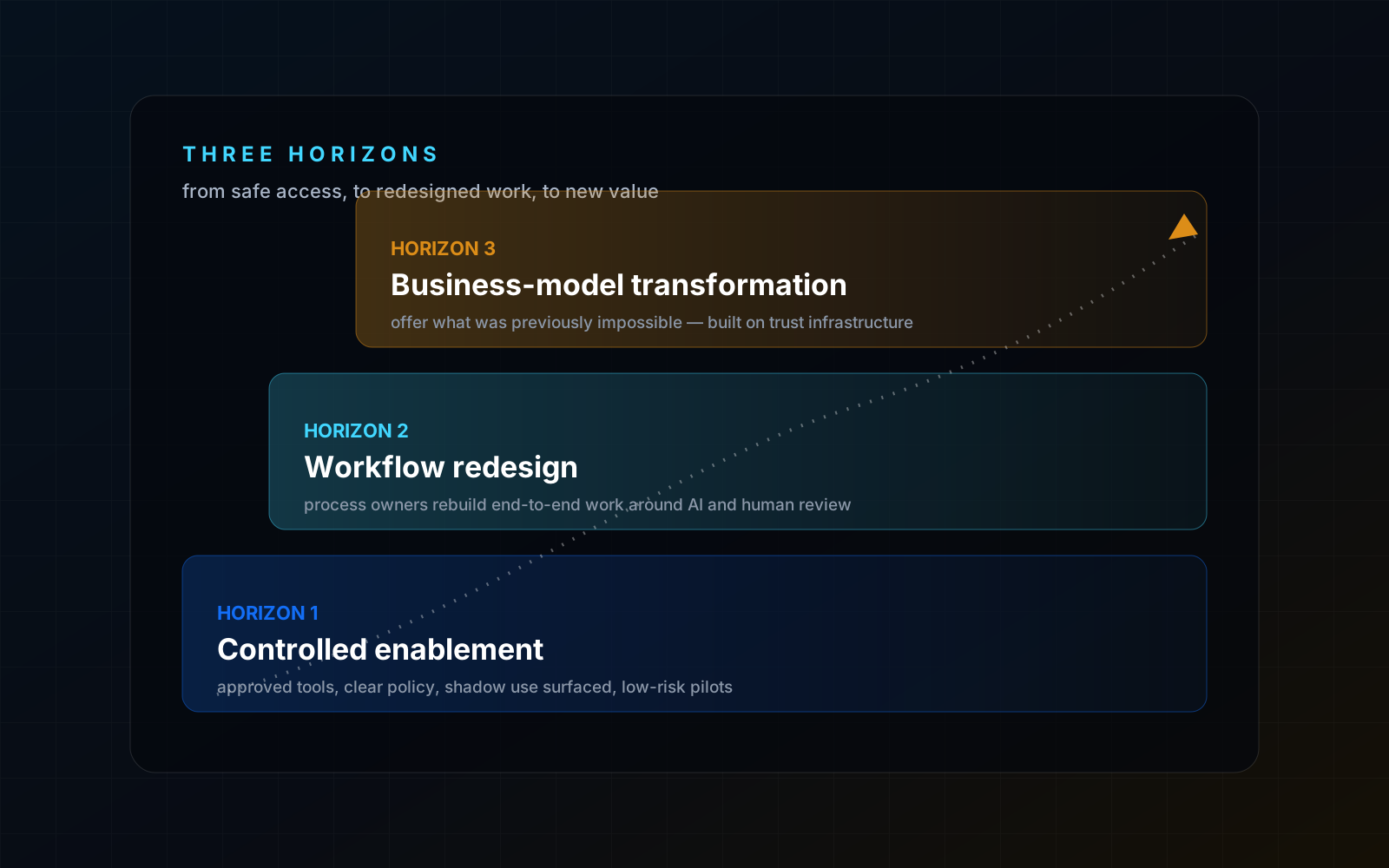
Three horizons, not three phases
The AI transition is best managed through three horizons: controlled enablement, workflow redesign, and business-model transformation. They are not rigid phases. They overlap, and a mature organization runs all three at once. But they give a useful structure for moving from experimentation to durable advantage.
The structure matters because it resists both failure modes. It does not wait passively for perfect regulation or perfect models, and it does not unleash AI into every process without control. It builds the harness while learning, moving from safe access to redesigned work to new value propositions.
Horizon 1: controlled enablement
The first horizon is about safe learning, not maximum transformation. Give employees approved tools, clear policies, and basic training. Find the shadow use that already exists and create a path to disclose it without fear. Launch low-risk pilots in drafting, summarization, internal search, customer support, coding assistance, document analysis, and meeting synthesis.
The goal is to learn where employees see value, where risks appear, which tools perform, what training is missing, and where data problems block progress. Horizon 1 should produce a use-case inventory, initial policies, risk tiers, approved tools, basic literacy training, and a small portfolio of measurable pilots.
Move quickly here, because unmanaged adoption is already happening. Delay does not prevent AI use; it only makes AI use less visible. Controlled enablement gives employees a legitimate way to experiment and gives leaders the visibility they need to govern.
Horizon 2: workflow redesign
The second horizon is where an organization moves beyond individual productivity and rebuilds specific processes around AI. Candidate workflows include sales enablement, service operations, the finance close, procurement review, software development, compliance monitoring, onboarding, recruiting, training, contract review, and internal knowledge retrieval.
This horizon requires process ownership. Someone must be accountable for the end-to-end workflow, not merely for tool usage. The workflow owner defines the baseline, redesigns the steps, sets quality standards, determines the human-review point, identifies data requirements, and tracks outcomes. AI is embedded where it improves performance, not offered as an optional side tool.
This is where gains become durable. Individual use saves time; process redesign changes the operating model. AI-assisted customer support is not just a suggested-response engine. It becomes a system for faster routing, better knowledge-base maintenance, agent coaching, quality monitoring, escalation prediction, and customer insight. The value comes from connecting the pieces.
Horizon 3: business-model transformation
The third horizon asks what the organization can now offer that was previously impossible or uneconomic. Once AI is embedded in workflows, the possibilities include personalized service at scale, faster product development, automated compliance evidence, AI-assisted advisory services, dynamic training, predictive operations, and new data-driven offerings.
This requires strategic imagination. The internet eventually changed not just internal communication but entire business models: e-commerce, digital advertising, streaming, software as a service, online marketplaces, and platforms. AI may produce analogous shifts in the economics of advice, personalization, software creation, research, education, and professional services.
But transformation should not be reckless. AI-native offerings must be reliable, governable, and aligned with customer trust. A company offering AI-powered advice has to explain, monitor, and control that advice. The strongest AI business models pair technical capability with trust infrastructure, because at this horizon the AI is the product, and its failures are the company's failures.
The staged approach avoids both extremes
Read together, the three horizons are a way to refuse the two tempting mistakes. Denial ignores the speed and breadth of adoption, and it does not actually stop adoption; it just hides it. Blind acceleration ignores reliability, security, privacy, intellectual-property, labor, and governance risk, and it eventually produces the incident that sets the whole program back.
Disciplined transformation is the alternative: map tasks, govern risks, train people, redesign workflows, secure data, measure outcomes, and create a transition path for the workforce. It is unglamorous, and it is what every successful technology transition in history actually required.
The historical record is consistent. Electricity reorganized factories. Spreadsheets reorganized analysis. The internet reorganized commerce, media, and trust. Each rewarded the organizations that redesigned work around the technology, not the ones that merely bought it.
The real question, and the real answer
The most important managerial question is not whether AI will replace people. It is how work will be decomposed, redistributed, supervised, and improved. Some tasks will be automated. Some will be accelerated. Some will become more valuable because human judgment is needed to review, contextualize, and govern AI output. Some roles will shrink while others expand, and new roles will form around workflow design, governance, knowledge management, and human-AI collaboration.
Organizations that treat AI as a tool rollout will get fragmented adoption, uneven quality, hidden risk, and disappointing productivity. Organizations that treat it as an operating-model transition will be positioned to turn experimentation into advantage, because they will know where AI is used, what value it creates, what risks it carries, who is accountable, how outputs are checked, and how work should change.
That is the whole argument of this series in one line. The organizations that succeed will not be the ones that simply use AI. They will be the ones that learn how to operate with AI.